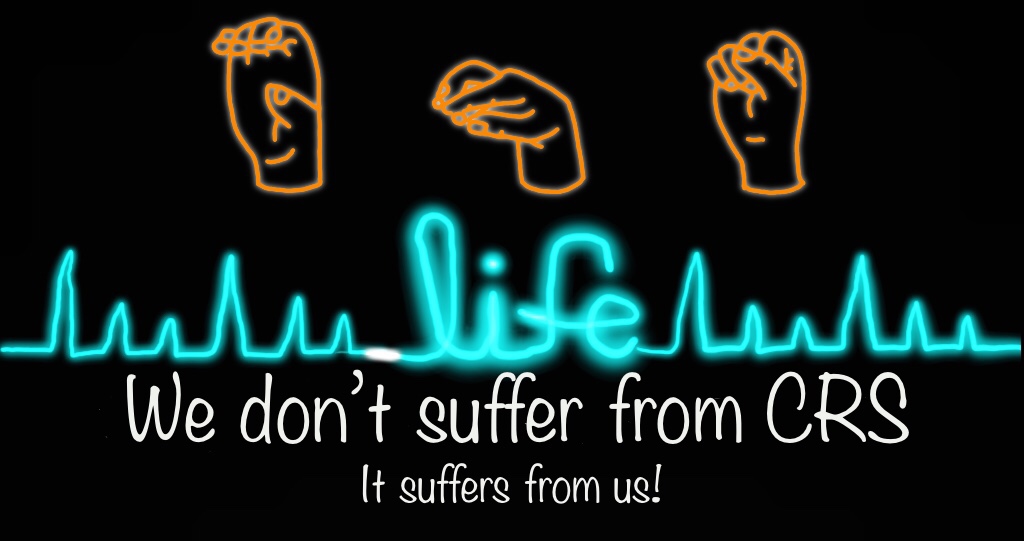
The Rubella virus damages many things which the foetus is in the process of developing at the time of infection during pregnancy. Nerves are very vulnerable. Particularly the auditory nerves associated with hearing.
Sensorineural hearing loss is therefore the most common type of hearing loss in CRS patients. Although this can occur due to any damage within the inner ear, in CRS patients it often occurs due to damage of the nerves which lead from the inner ear to the brain. As with any type of hearing loss, sensorineural hearing loss exists in varying degrees depending on the ammount of damage.
How much a person hears is measured using frequency (how high or low something sounds) and volume (how loud something sounds). The more volume required to be able to hear a specific frequency, the more hearing loss that a person may be experiencing.
A typical individual with good hearing can hear frequencies ranging from 125 to 8,000 Hertz (Hz) at a volume somewhere between 1 and 25 Decibels (dB). Hearing loss is present when any or all of these frequencies can only be heard from 26dB or higher.
Mild hearing loss: 26 to 40dB. It can be difficult to hear soft speech and the person may ask another to speak louder or repeat themselves.
Moderate hearing loss: 41 to 55dB. It can be hard to hear certain vowels and consonant sounds used in speech. Many with moderate hearing loss say they can hear, but can’t necessarily understand unless they are wearing hearing aids.
Moderately severe hearing loss: 56 to 70dB. It’s not possible to hear speech without hearing aids. Although amplification provided by hearing aids doesn’t always help. Speech may be heard but not understood.
Severe hearing loss: 71 to 90dB. Without hearing aids or cochlear implants. it’s not only the ability to hear speech which is affected. It also becomes difficult to hear other sounds, such as a barking dog.
Profound hearing loss: 91dB and above. This is when loud sounds such as an airplane is not heard without hearing aids or cochlear implants.
Other types of hearing loss include;
Conductive hearing loss: This occurs when sound cannot get through the outer and middle ear. It has many different causes, including deformities of the outer or middle ear. This can occur as the foetus is developing while the Rubella virus is present. However, it is not common.
Mixed hearing loss: This is caused by a combination of problems with the outer, middle and / or inner ear as discussed above.
How a person with hearing loss communicates depends on personal choice, as well as the severity of the hearing loss. Those with mild or moderate hearing less are likely to be able to communicate verbally and therefore choose to do so. Those with moderately severe hearing loss or worse, may only be able to efficiently communicate using sign language. Although it can too often be difficult to gain access to learning sign language and the individual may instead have been enrolled in speech therapy to learn to communicate verbally in combination with lip reading.
However, not all deaf people can lip read and not all deaf people can sign. Equally, not all deaf people wear a hearing aid or cochlear implant. Some don’t have access to this technology. Others choose not to. Also, it may simply just not help. Many people with CRS don’t qualify for a CI due to the ammount of nerve damage caused by Rubella.
It’s therefore important to consider and respect the situation of each individual. You can find out more about learning sign language by visiting our links page.
Sources:
asha.org
hearinghealthfoundation.org
 CRS Life