Living with multiple illnesses, disabilities, and daily challenges has taught me a great deal—not just about myself, but about the people around me who don’t walk in my shoes. I’m not talking about my family or close friends, the ones who’ve watched me grow and adapt. I’m talking about society at large, and the professionals I regularly encounter in medical and care settings.
Some people have a remarkable ability to speak to me and treat me with such respect and dignity that, for a moment, I forget about my challenges altogether. Others notice my visible disabilities—how carefully I navigate a room or pour a cup of tea—and grab onto that information with both hands. Often this comes from a good place and can be genuinely helpful. Other times, it turns into overbearing or overprotective behaviour that prevents me from doing things I’ve been doing independently for years. And then there are the few who seem unsure how to approach me at all. Whether it’s fear or a lack of understanding, I don’t know. What I do know is that it’s possible to feel incredibly lonely in a room full of people.
When I tell someone I’m Deafblind, one of three things usually happens.
The first is the assumption that Deafblind means total darkness and complete silence. This happens more often than you might think—and yes, I’ve even been accused of faking it. I don’t live in a world without sight or sound, guys. Many Deafblind people don’t. It’s a spectrum.
The second reaction is where the blind part is fully acknowledged. People often have very concrete ideas about how to communicate with and assist blind people. Whether those ideas are helpful or wildly off the mark varies from situation to situation.
The third reaction is my favourite: questions. Lots of them. While many in the Deafblind community value their privacy and feel there’s a time and place for curiosity—which I fully respect—I happen to be an open book. If you genuinely want to learn, I’ll answer. Just be warned: if you ask something personal, you may receive far more detail than you bargained for.
What tends to take a back seat, however, is the Deafness—or as I prefer to call it, my hearing challenges. If you wear hearing aids and speak without a so-called “Deaf accent,” people often forget you have any challenges at all. The assumption seems to be that hearing aids fix you. They don’t. Hearing aids are tools, not cures. They’re amplifyers. Not a speech isolation system. At best, they offer more clarity. If you’re very lucky, they give you access to sounds you wouldn’t hear otherwise. But the person wearing them is still Deaf or Hard of Hearing, and there will still be many situations where hearing is a struggle—even with the technology.
Let me explain how this works for me.
I have mild to moderate hearing loss. Why not just one or the other? Because one ear hears better than the other.
I can hear low tones: drums, bass guitars, a large dog barking, deep masculine voices.
I hear some mid-range tones: the first two-thirds of a piano, a vacuum cleaner, a washing machine. But they sound quieter to me than they do to you. To hear them comfortably, I need a volume that would likely hurt your ears.
High tones, however, are mostly absent. No birds. No beeps from small electronic devices. High-pitched feminine voices are difficult for me to understand.
In a room with normal background noise—like a TV on softly, dishes clinking, or other people talking in the background—my speech recognition without hearing aids is roughly 40–50%. That means I miss about half of what’s being said and have to guess the rest from context. Conversations move on before I’ve fully pieced them together.
With my hearing aids in, I regain clarity and access to more sound. In a quiet one-to-one setting, I can score close to 100% on a speech recognition test. But the real world isn’t a test booth. In a room with normal background noise, my understanding is around 70%. That may sound high, but it still means I miss roughly three out of every ten words. I can usually reconstruct the meaning—but it takes effort, concentration, and energy.
So when you ask me, “Do you want a cup of tea?” I’ll probably understand, “You want tea?” If the room is perfectly silent, I might catch the whole sentence. But the world is rarely silent. There’s almost always background noise.
And here’s the kicker: the world is loud. Wearing hearing aids requires my brain to work significantly harder to process and filter sound in order to make sense of it all. This leads to something called listening fatigue. Combine that with limited visual processing, and the result is overstimulation, sometimes exhaustion and—if it goes on too long—cognitive disfunction.
For six years, I’ve been stuck with a choice. Wear the hearing aids and deal with the consequences: fatigue, headaches, and impaired thinking. Or take them out, which restores energy and mental clarity but leaves me hearing less overall and understanding even fewer words. I can’t see enough to lipread, my family knows some signs but not enough for full conversations, and much of the world outside my family seems to have an aversion to sign language altogether.
The result? I often feel like half a person.
Recently, I registered with an organisation that supports d/Deaf, Hard of Hearing, and Deafblind people. Their work includes advocacy, mental health support, and—most importantly for me—learning alternative ways to communicate.
I lose concentration quickly in conversations. I become less engaged as I work harder to stay focused and stop my thoughts from wandering off. I want to change that.
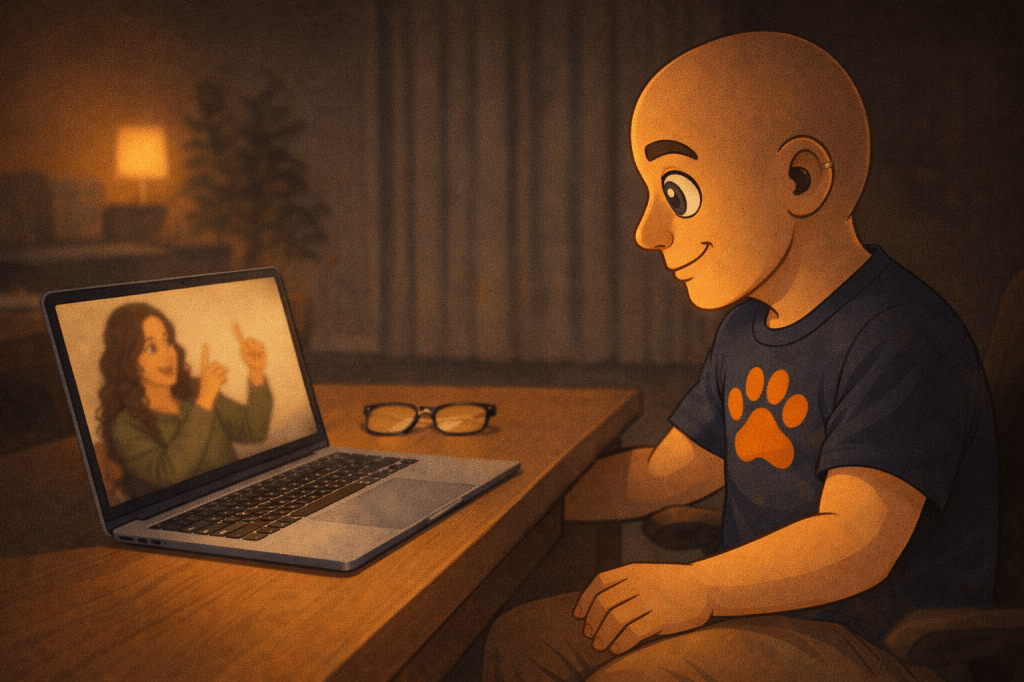
During a recent video call with someone from the organisation, we discussed everything I’ve shared in this blog and how my vision loss and hearing challenges interact. While talking about my eyesight, I showed them my filter glasses and explained how the yellow lenses give me slightly more visual clarity. The moment they realised I could see their hands better, they switched from speaking with the occasional sign to fully sign-supported Dutch.
I was blown away.
Being able to listen without straining, while watching signed information fill in the gaps, allowed me to concentrate fully and feel completely engaged. It was like someone had turned on the lights in a room where I’d been living in the dark for years. For the first time in a long time, I felt whole.
There will be more conversations before I know whether this organisation can truly help me. But right now, I’m hopeful. A stranger saw all of me in a 45-minute video call. That’s something special.
My family has spent years teaching me the importance of advocating for myself and doing what works for me. After that call, I can see just how right they are.
The moral of this story, Gentle Readers, is this: focus on doing what works for you. Try not to lose yourself along the way. Remember that you matter—and that the people who truly care about you have been telling you this all along. 💛
 CRS Life